


Empowering Integrity. Building Trust.
BDI's learning arm turns casework into training, so your own people catch the same issues earlier.


The Brand Defence Academy is BDI's learning arm. It converts what our investigators find at plants, depots, offices and dealer counters into short, practical courses, so the same issues are caught earlier by your own people. Every course uses cases from your sector, your own systems and the language of the shop floor, and can be delivered on site in English, Hindi or regional languages.
The Academy is part of BDI and is led by its founders. Every programme draws on real investigations and ends with an assessment and a certificate.
From the plant floor to the boardroom.
Plant and site teams
Weighbridge, stores, fuel and scrap controls.
Procurement and stores
Vendor selection, bids, purchase orders and receipts.
Sales, logistics and dealers
Depots, transporters, dealers and channel partners.
Audit, HR and Internal Committee members
Investigations, interviews and POSH inquiries.
Leadership and board
Fraud risk, competition law and DPDP duties.
Four formats, each built around your teams.
Delivered in classrooms, on site or online, in English, Hindi or regional languages.
Certification programmes
Multi-day courses mapped to ACFE and COSO fraud curricula, with assessment and certification.
Plant and zone workshops
Half-day and one-day sessions run at plants, depots and zonal offices.
E-learning modules
Self-paced modules for large teams, tracked through your own learning management system.
Leadership briefings
Briefings for boards and leadership on new cases, competition-law trends and DPDP duties.
10 courses in three tracks.
Every course is adapted with cases from your sector, your own policies and systems, and the language of your teams, and ends with an assessment and a certificate.
Ethics & Compliance
- 1.1Conflicts of Interest
Recognising, declaring and managing actual, potential and perceived (apparent) conflicts of interest.
What the course covers
- What a conflict of interest is: actual, potential and perceived, and why perception alone can damage trust.
- Where conflicts come from: financial interests, family and close relationships, outside roles, gifts and hospitality, and moves between employers.
- Declaring well: when to declare, what to disclose, and keeping declarations current at joining, every year and whenever circumstances change.
- Managing a declared conflict through recusal, reassignment, approvals and monitoring, recorded so the decision can be defended later.
- The red flags reviewers look for, illustrated with anonymised cases from BDI investigations.
- Your organisation's own policy and declaration process, built into the session.
Built onOECD guidance on managing conflict of interestISO 37301 compliance management systemsISO 37001 anti-bribery management systems
- 1.2Moonlighting & Parallel Employment
When outside work, side businesses and parallel employment cross the line, and how to declare them.
What the course covers
- What counts as moonlighting, dual employment and a side business, and when outside work is acceptable.
- The risks: conflicts of interest, misuse of working time, and leaks of confidential information and intellectual property.
- The position in India: what employment contracts, service rules and company policies typically require.
- Remote and gig work: how to assess an outside engagement before taking it on.
- Declaring outside work and seeking approval, and the consequences when it is not declared.
- Anonymised case studies of undeclared parallel employment uncovered in investigations.
Built onOECD guidance on managing conflict of interestISO 37301 compliance management systemsYour code of conduct and employment terms
- 1.3Financial Transactions with Business Partners or their Connected People
Loans, investments, payments and favours involving vendors, customers, dealers or people connected to them.
What the course covers
- Which transactions are in scope: loans, investments, guarantees, payments, gifts and favours involving vendors, customers, dealers or people connected to them.
- Who counts as a connected person: relatives, close associates and the entities they control.
- Why these transactions create risk: undue influence, kickbacks disguised as loans or investments, and conflicts of interest.
- Related-party rules for companies: approvals and disclosures under Companies Act s.188 and, for listed entities, SEBI LODR Reg. 23.
- Declaring, seeking approval and keeping records that stand up to audit.
- Red flags and anonymised cases from BDI investigations.
Built onIAS 24 / Ind AS 24 Related Party DisclosuresCompanies Act, 2013 s.188 and SEBI LODR Reg. 23ISO 37001 due diligence on business associates
- 1.4Anti-Bribery & Anti-Corruption
Bribery red flags, gifts and hospitality, intermediaries and the Prevention of Corruption Act, 1988.
What the course covers
- What bribery is, whether paid directly or through intermediaries, including facilitation payments.
- Gifts, hospitality, donations and sponsorships: what is acceptable, and how to record and approve them.
- Third parties: due diligence on agents, distributors and consultants, and the red flags that call for escalation.
- The law that applies: the Prevention of Corruption Act, 1988 (including the liability of commercial organisations under s.9), the US FCPA and the UK Bribery Act 2010.
- What an adequate anti-bribery programme looks like: tone from the top, risk assessment, controls, training, speak-up and monitoring.
- Dilemmas and case studies drawn from BDI investigations.
Built onISO 37001 anti-bribery management systemsUN Convention against Corruption (UNCAC)OECD Anti-Bribery ConventionUK Ministry of Justice guidance on adequate procedures
Prevention of Sexual Harassment
- 2.1POSH Training
The POSH Act, 2013: what amounts to sexual harassment, how to raise a complaint, and the Internal Committee's role and timelines.
What the course covers
- What amounts to sexual harassment at work under the POSH Act, 2013, including situations online, off-site and on work travel.
- Who the Act protects, and how many organisations extend their policies to every employee.
- How to raise a complaint, how confidentiality works, and protection against retaliation.
- The Internal Committee: its composition, the inquiry procedure and the timelines (inquiry within 90 days, the employer's action within 60 days).
- What managers and colleagues should do when they see or are told about harassment.
- The employer's duties: policy, awareness, the Internal Committee and annual reporting.
Built onPOSH Act, 2013 and its RulesILO Violence and Harassment Convention, 2019 (No. 190)ISO 45003 psychological health and safety at work
Regulatory & Compliance
- 3.1UPSI / Insider Trading
Unpublished price-sensitive information, trading windows, designated persons and the SEBI insider-trading regulations.
What the course covers
- What unpublished price-sensitive information is, with everyday examples: results, mergers, major contracts and leadership changes.
- Who is an insider, a designated person or a connected person.
- Trading windows, pre-clearance of trades and the restriction on contra trades.
- Sharing UPSI only for legitimate purposes, maintaining the structured digital database, and handling leaks.
- Disclosures, penalties and how SEBI enforces the regulations.
- Reporting suspected leaks of UPSI under the whistle-blower policy required by Reg. 9A(6).
Built onSEBI (Prohibition of Insider Trading) Regulations, 2015IOSCO Objectives and Principles of Securities RegulationEU Market Abuse Regulation (for comparison)
- 3.2FCPA and its Components
The US Foreign Corrupt Practices Act: its anti-bribery provisions and its books-and-records and internal-controls requirements.
What the course covers
- Who the FCPA applies to (issuers, domestic concerns and those acting in the US) and how Indian companies and their staff can come within its reach.
- The anti-bribery provisions: corrupt payments to foreign officials, including payments made through third parties.
- The accounting provisions: accurate books and records, and an adequate system of internal accounting controls.
- The exception for facilitating payments and the defence for reasonable, bona fide expenditure.
- Enforcement by the DOJ and SEC, penalties, and what prosecutors expect of a corporate compliance programme.
- Lessons from enforcement actions, translated into everyday controls.
Built onUS Foreign Corrupt Practices ActDOJ and SEC Resource Guide to the FCPADOJ Evaluation of Corporate Compliance Programs
- 3.3DPDP at a Glance
The Digital Personal Data Protection Act, 2023 and its Rules: rights, duties, consent and penalties.
What the course covers
- Why the Digital Personal Data Protection Act, 2023 matters and who it applies to, including processing outside India in connection with offering goods or services in India.
- The key roles: data principal, data fiduciary, data processor, consent manager and significant data fiduciary.
- Lawful processing: notice and consent, and the legitimate uses that do not need consent.
- Individuals' rights: access, correction and erasure, grievance redressal and nomination.
- Organisations' duties: security safeguards, breach notification and limits on how long data is kept.
- The Data Protection Board of India and penalties of up to ₹250 crore.
Built onDPDP Act, 2023 and DPDP Rules, 2025OECD Privacy GuidelinesGDPR principles (for comparison)
- 3.4DPDP Implementation
Notices, consent, security safeguards, breach response and the timeline for compliance under the DPDP Rules.
What the course covers
- Building the data inventory: what personal data you hold, where, why and for how long.
- Notices and consent that meet the DPDP Rules, with consent records and easy withdrawal.
- Security safeguards, and contracts with the data processors who handle data for you.
- Breach response: detection, notice to the Data Protection Board and to affected individuals, and the evidence to keep.
- Handling rights requests and grievances within the prescribed timelines.
- A phased plan to the compliance date set by the DPDP Rules, with owners and evidence for each step.
Built onDPDP Act, 2023 and DPDP Rules, 2025ISO/IEC 27001 information securityISO/IEC 27701 privacy information management
- 3.5UCPMP Effectiveness
Testing whether controls over interactions with healthcare professionals under UCPMP 2024 actually work.
What the course covers
- What UCPMP 2024 requires: no gifts or personal benefits, limits on samples and brand reminders, and CME and CPD events held in India with spend disclosed.
- The executive head's annual self-declaration, and the evidence that should sit behind it.
- How to test controls over HCP engagement: camps, CMEs, samples, consultancy fees and field-force claims.
- Data analytics and red flags across expense, CRM and event records.
- Complaints to an Ethics Committee for Pharma Marketing Practices, and how to respond.
- Designing corrective actions that close the gaps the review finds.
Built onUCPMP 2024, Department of PharmaceuticalsIFPMA Code of PracticeUS Sunshine Act (for US operations)
Combine courses into a certification programme, plant workshops or e-learning for your teams.
This is a summary of the curriculum. For a deeper understanding of how it would work for your organisation, please reach out to us.
Talk to a BDI partnerOne base for every course, and a certificate that can be verified for years.
- Clear learning objectives, set with you before the course is designed.
- Content mapped to recognised international frameworks and to Indian law.
- Case studies from BDI casework, anonymised and matched to your sector.
- Your own policies, systems and examples built in.
- An assessment for every participant.
- A Brand Defence Academy certificate with a fingerprint anchored on the Bitcoin blockchain, so it can be verified for years.
Courses reference the frameworks shown to set a recognised base. They are not accredited or endorsed by the bodies that publish those frameworks.
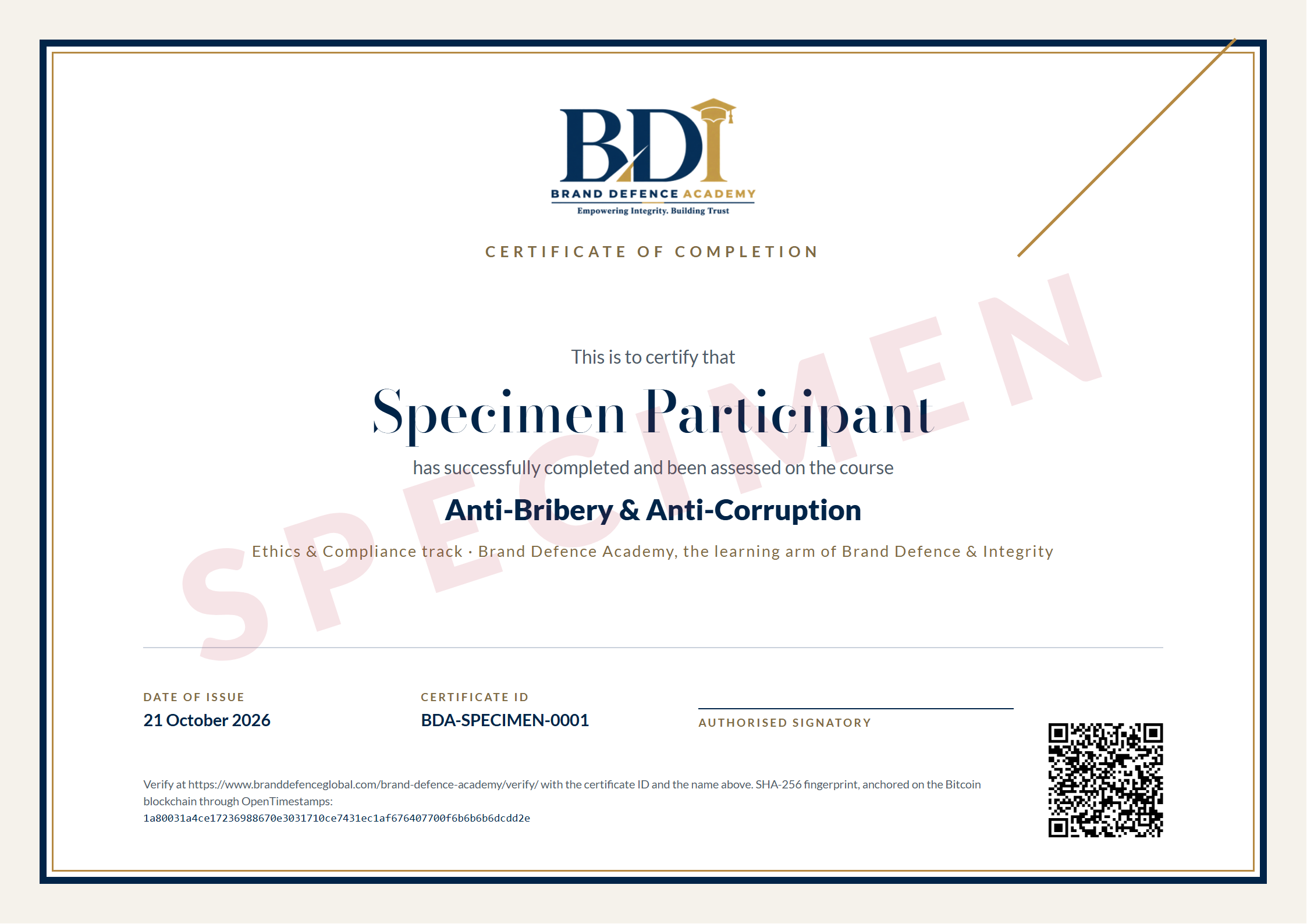
- IssuedEvery certificate carries a unique ID and the participant's details.
- FingerprintedThose details produce a SHA-256 fingerprint, anchored on the Bitcoin blockchain through OpenTimestamps.
- VerifiedAnyone can check a certificate on this site, or independently with free OpenTimestamps tools, for years to come.
Courses matched to the platforms they support.
Training works best alongside the controls it explains. Each BDI platform comes with the courses and workshops that help people use it well.
Diagnose. Design. Deliver. Assess. Certify.
- 1
Diagnose
Agree the audience, the risks and the outcomes.
- 2
Design
Build the course from BDI casework relevant to your sector.
- 3
Deliver
Classroom, on site or virtual, in English, Hindi or regional languages.
- 4
Assess
Every participant is assessed.
- 5
Certify
A certificate for every participant who passes.
Training that answers a real trigger.
A new code of conduct or policy
Rising helpline volumes
Counterfeits reaching your channel
A new Internal Committee under POSH
A board that wants to understand fraud risk
A regulator asking about training